![[personal profile]](https://www.dreamwidth.org/img/silk/identity/user.png) lethargic_man
lethargic_manMy brother gave me this book for my birthday, along with a card reading "Read this and let me know how far you've got when you've worked out whether it is a piss-take or not." (Stop reading now if you don't want to know the answer!)
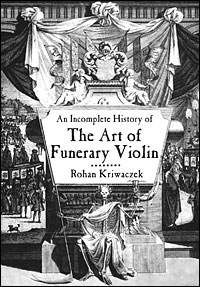
My initial reaction was puzzlement. The subject matter, and indeed the title, sounded faintly absurd, and the sense of absurdity was only increased on seeing, on a brief flick-through, references to the likes of the Erroneous Dirge of George Babcotte. But the length of the book—two hundred pages, including many pages of printed music (also available on a separately sold CD (hear excerpts*))—and the fact it was written in what appeared to be a completely straight style argued against it being a parody. How could anyone put in all the effort necessary to make a book this long on a fake subject matter, and then not even make it funny?
* I'm glad I stumbled across these; there's an entire appendix dedicated to the long-running argument amongst virtuoso funerary violinists as to whether a drum ought to be allowed in funerary violin music, which is; the excerpts at the above site nicely illustrate both Herr Gratchenfleiss's original horror at perverting the traditional solo status of the violin, and how he came to warm to it afterwards.
Reading it, there was never a single point at which I decided it was a parody. Rather, the probability I thought it was one started a little over fifty per cent and gradually rose to ninety-five per cent, and then eventually ninety-nine per cent. But it was still a very odd book. Really, for a book intended as a parody, one would have thought it would have been funnier. There were a few odd moments in it that made me laugh—the revelation, for example, that the document written by a highly unstable character in a dark brown ink, and marked with stains of the same, which had been thought to have been written in blood, had recently been revealed by chemical tests to have in fact been written in very strong coffee—but only a few.
It's possible that there were references in it that I missed, which would have livened up my reading of the book. An example of such a reference that I did get was the casual name-dropping, buried in a list of other names, of an eighteenth century character called Alfred Quimby. Drop the first two letters and the name will be familiar from the credits in the title sequence of every Tom and Jerry cartoon.
The book is stuffed full of fake evidence into the construction of which an incredible amount of effort must have gone—paintings, portraits and old photographs, all showing the appropriate period dress; musical scores (and the recordings on the CD, the ones purporting to have been recorded in the early twentieth century sound like one would expect them to), and letters and other documents, in some cases showing hints at the text on the other side of the page, words of which can be made out with the use of a mirror (though to my disappointment this backwards-masking did not reveal anything satanic, or otherwise admitting the joke).
Wikipedia quotes the author as saying:
that his book is neither a hoax nor an attempt to mislead[; that] he wanted to "expand the notion of musical composition to encompass the creation of an entire artistic genre, with its necessary accompanying history, mythology, philosophy, social function, etc."
I suppose, as a writer of fantasy and science fiction, the worldbuilding for projects of which have sometimes gone way over what is required for the work in question, I can sympathise with that; but it was probably a hell of a risk to take putting so much effort into something which might be proved unpublishable, or flopped badly once the cat was out of the bag. Mind you, if it develops a cult following, I can see its fandom creating the genre of funerary violin...
The book does have a serious side, in the form of critique of the attitudes towards death in our culture. This critique runs through much of the book as an undercurrent, but rises to the fore near the end.
Finally, as to the question of why my brother chose this book to get me, I'd guess it may have been in response to my getting him another fictional story in a form wildly divergent from that of the traditional novel: Pale Fire, by Vladimir Nabokov. (Indeed, there was one point, towards the end, where I thought the author might be building towards a Pale Fire-style revelation (ROT13'ed to avoid Pale Fire spoilers) gung gur jubyr sharenel traer zvtug nyy or va uvf urnq (v.r. gur urnq bs gur va-obbx aneengbe jvgu gur fnzr anzr nf gur nhgube, but this did not turn out to be the case.)


An incomplete history of the art of funery violin
Date: 2007-04-12 10:01 pm (UTC)Anyway, the reason for that great preamble is because I had the opportunity to browse a large number of books during the interval, none of which I had any intention of buying. The books at the JBW are quite easy to class into a number of obvious stereotypes: Holocaust, Israeli fiction, guides to frumkeit, more Holocaust...
However, in the midst of the mellee, I also stumbled accross "An incomplete history of the art of funery violin" and I was intrigued by the cover, and the seeming lack of connection to anything Jewish. I picked up the book, and spent the next 10 minutes flicking back and forth trying to work out whether it was for real. Yes, I agree, the cover is slightly comic, but open it up, and the content looks like pure historical academia.
Eventually, I had to put it down, although my level of intrigue was high enough that I almost bought it just to try and work out whether it was a parody or not. That would be silly though. I have a huge pile of books I really want to read, and many of them are borrowed. I don't have enough reading time in my life to read all the books I REALLY want to read to read a whimsical fancy like this. But oh, I was so intrigued.
Eventually, I hit upon the solution. I would buy the book, and get SOMEONE ELSE to do all the hard work for me! That's when I thought of you, Michael.
Thanks,
Paul
So, PS: nothing to do with Pale Fire, but I knew you'd like it!
Re: An incomplete history of the art of funery violin
Date: 2007-04-13 09:36 pm (UTC)I like your reasoning... <EG>